Okay, can we talk about the playroom for a second? Because somewhere between the third LEGO-underfoot injury and the fifth time you found crayon on the wall “just testing colors, Mummy,” you probably typed “kids playroom ideas” into Google at 11pm, desperate for a fix that doesn’t cost a small fortune.
I’ve been there. More than once. And here’s the thing nobody tells you: a great kids’ playroom isn’t about matching storage bins or a Pinterest-worthy reading corner with fairy lights (although, no judgment, those are cute). It’s about creating a space that actually *works* — for your kids’ energy, your sanity, and the square footage you’re actually working with, whether that’s a full extra room or just a corner of the living room you’ve reclaimed.
Before we get to the actual ideas, one quick reframe that changed everything for me: your playroom doesn’t need a “theme.” It needs a *system*. Kids don’t care if the space looks like a Montessori showroom — they care whether they can find their toys, use them, and (ideally) put them back without you hovering over them like a toy-sorting drill sergeant. Every idea below is built around that principle: make it easy for a small human to succeed independently.
And if your kids love being outside too, check out my Backyard Play Areas for Kids for easy ways to create a fun outdoor space.
So let’s get into it. These are real, doable kids playroom ideas you can start today, not someday.
1. Zone It Like a Tiny Apartment
This is hands-down the most useful of all kids playroom ideas, so I’m putting it first. Instead of one big toy-dumping-ground, break the room into zones:

– A **building zone** (LEGO, blocks, magnetic tiles)
– An **art zone** (crayons, paper, washable everything)
– A **reading nook** (soft seating, low shelf of books)
– A **pretend play zone** (kitchen set, dolls, dress-up)
You don’t need walls or dividers — a rug under each zone is enough of a visual cue for kids to understand “this is where this stuff lives.”
2. Low Shelving Is Non-Negotiable

If your kids can’t reach it, they can’t clean it up, and they definitely can’t play independently. Swap tall shelves for low, open ones at your child’s eye level. This single change cuts down on the “Mummy, get it for me” requests dramatically.
3. The Bin-Per-Category Hack

Skip the giant toy chest where everything gets swallowed whole. Instead, use clear or labeled bins — one per toy category. Cars in one, blocks in another, puzzle pieces in a third. When toys have a “home,” clean-up time stops being a battle.
4. Picture Labels for Pre-Readers
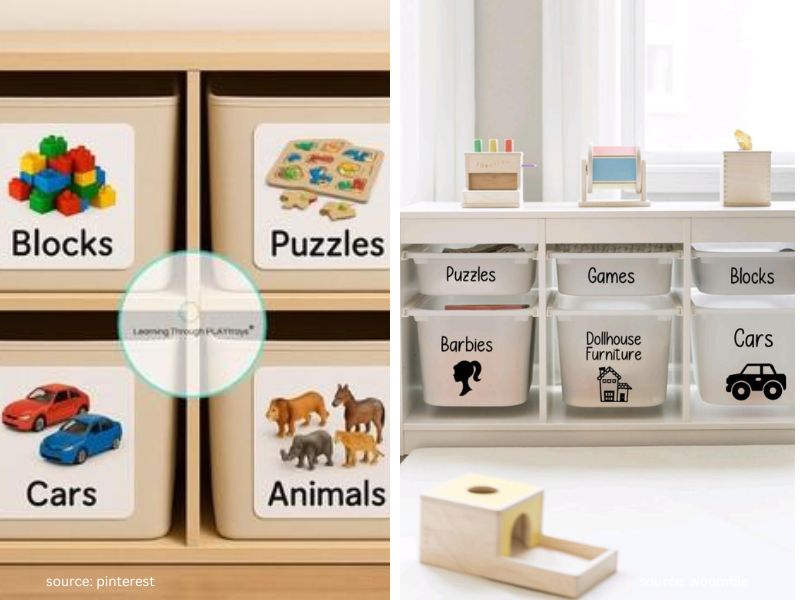
For toddlers and younger kids who can’t read yet, tape a printed picture of the toy onto the bin. It sounds small, but it’s genuinely one of those kids playroom ideas that quietly does a lot of heavy lifting — kids match the toy to the picture and clean-up becomes a game instead of a chore.
5. A Rotating Toy Library
Here’s a hack that changed my house: instead of every single toy being out all the time, keep two-thirds of the toys in a closet or storage bin and rotate them every couple of weeks. Fewer toys out = less overwhelm, less mess, and kids actually re-fall in love with toys they’d forgotten about.
If you’re also trying to get the rest of your child’s room under control, don’t miss my 21 Kids Room Organization Ideas That Actually Work for more simple storage and cleanup systems.
6. Repurpose Before You Buy

Before you spend on new playroom furniture, look around your house first:
– An old bookshelf laid on its side becomes cubby storage
– A bathroom caddy becomes a crayon organizer
– A shoe organizer on the back of the door becomes small-toy storage
– An unused coffee table becomes a Lego building station (bonus: hot glue a Lego base plate to the top)
7. Soft Rug and Flooring
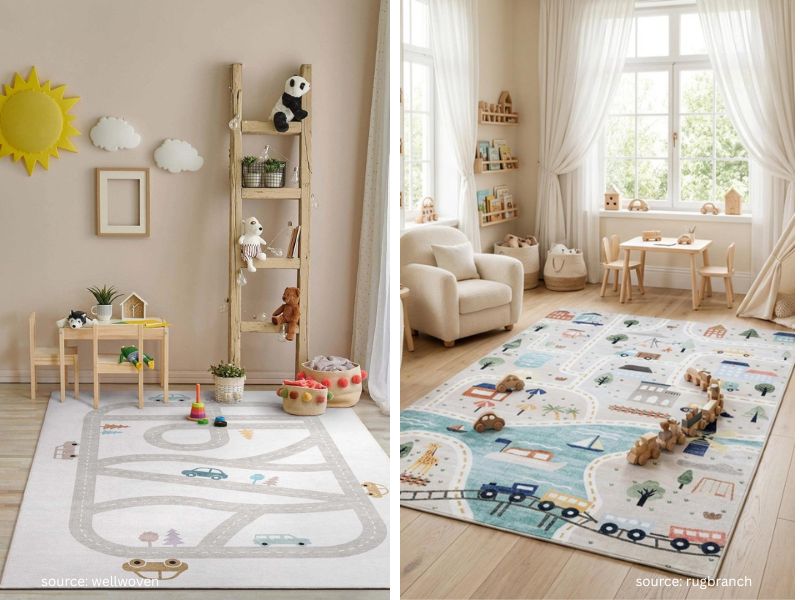
A play mat, rug, or foam tiles instantly makes a space feel like “the playroom” even if it’s a shared living room corner. It also softens falls and gives kids a clear boundary for where toys belong.
8. The Command Center Wall

Dedicate one small wall to a corkboard or magnetic chalkboard where kids can display their art, a visual chore chart, or a “today’s plan” board. It gives them a sense of ownership over the space, which — surprisingly — makes them more invested in keeping it tidy.
9. Build a Reading Nook, Even a Tiny One

A bean bag, a small basket of books, and decent light. That’s it. That’s the whole hack. You don’t need a canopy tent (though cute) — you need somewhere cozy your child associates with quiet, calm play.
10. Height-Appropriate Everything
Tables, chairs, hooks, shelves — if it’s sized for adults, kids will struggle and eventually stop using it “correctly.” Kid-height furniture is one of those kids playroom ideas that feels obvious once you see it in action: independence goes way up.
11. Use Vertical Space for Bulky Toys
Stuffed animals, balls, and oversized toys eat up floor space fast. A hanging net hammock in a corner or wall-mounted hooks keeps bulky items up and out of the walking path.
12. A “Yes Space” for the Little Ones
If you’ve got a toddler mixed in with older kids, carve out a small, safe corner just for them — soft mats, no small choking-hazard pieces, low shelf with baby-safe toys. It keeps everyone playing in the same room without constant supervision stress.
13. Washable Everything
Washable paint, washable markers, a wipeable table surface, a rug that can go in the machine or be vacuumed easily. Future-you will thank present-you.
14. Let Furniture Do Double Duty

An ottoman with storage inside. A bench that opens up. A table with a bin underneath. In smaller homes especially, dual-purpose furniture is one of the smartest kids playroom ideas for stretching limited space.
15. A “Mess Mat” for Messy Play

If your kids love slime, sand play, or messy art projects, designate one specific spot — a large washable mat or an old shower curtain taped down — as the official messy-play zone. It contains chaos without banning the fun.
16. Add a Photo or Growth Chart
A small wall decal growth chart or a rotating photo display personalizes the space and makes it feel like *theirs*, not just a storage room for toys.
17. Keep a “Landing Basket” by the Door
A basket right at the playroom entrance for toys that migrate out of the room during the day. Instead of chasing down stray blocks all over the house, everything gets tossed back in on the way out, and you do one final sort later.
18. Involve the Kids in the Setup
This one’s more mindset than hack, but it matters: let your kids help decide where things go, even if their “system” doesn’t fully make sense to you. Kids maintain systems they helped build far more than systems imposed on them.
19. Lighting Matters More Than You’d Think

A bright, well-lit room (natural light if you can get it, warm lamps if you can’t) makes a huge difference in how long kids willingly play in a space versus wandering off to find you in the kitchen.
20. Budget-Friendly Doesn’t Mean Boring
You really don’t need to spend a lot to make this work. A fresh coat of paint, a thrifted rug, repurposed furniture, and printed labels can transform a bland corner into a space your kids genuinely love — all without matching every bin to a color-coded aesthetic.
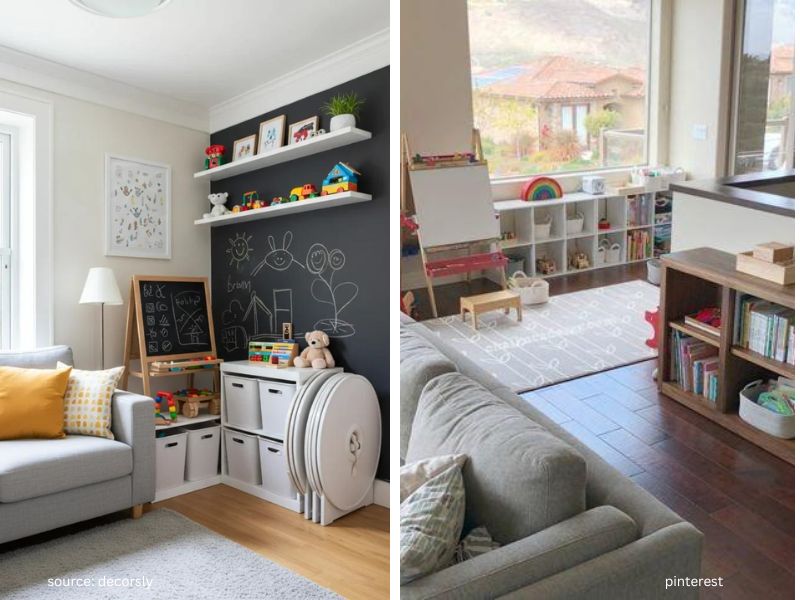
Even if you have a small space you can carve out a small space in your living room or even bedroom as their play area.
How to Pick Your 4 (So You Don’t End Up Overwhelmed)
Twenty kids playroom ideas is a lot to look at, so let’s simplify. You don’t need all of them — you need a small, cohesive set that actually fits your space and your kids. Here’s the easiest way to narrow it down:
**Start with the non-negotiable core (always include these four):**
– Zoning (#1) — this is the foundation everything else builds on
– Low shelving (#2)
– Bin-per-category storage (#3)
– A rug or soft flooring (#7)
**Then add 2–3 “personality” picks based on your kids:**
– Book-loving kids → reading nook (#9)
– Art or sensory kids → mess mat (#15)
– A toddler in the mix → yes-space (#12)
– Kids who love showing off their work → command center wall (#8)
**Treat everything else as optional extras, not requirements.**
Growth charts, hanging storage, photo walls — lovely touches, but adding too many at once is what turns a functional playroom back into clutter. If in doubt, ask: does this help my child play and clean up independently, or is it just decoration? Independence-boosting ideas go in first; decoration comes later, if at all.
The Real Secret Behind Good Kids Playroom Ideas
If there’s one thing I want you to walk away with, it’s this: the best kids playroom ideas aren’t the prettiest ones, they’re the most *functional* ones. A space your child can navigate, tidy, and enjoy on their own is worth infinitely more than one that photographs well but falls apart by 10am.
Start small. Pick two or three ideas from this list, not all twenty. Try zoning, add low shelves, throw in a rotating toy system, and see how much calmer things feel within a week. You can always build from there.
And if you try any of these, I’d genuinely love to hear which one made the biggest difference in your house — drop it in the comments!
I hope this was helpful
Thanks for Reading!!!
With Love
Adaego
Leave a Reply